This World Mental Health Day is an opportunity to remember the importance of seeking support when we need it and offering a listening ear to anyone who may be struggling with life’s challenges.
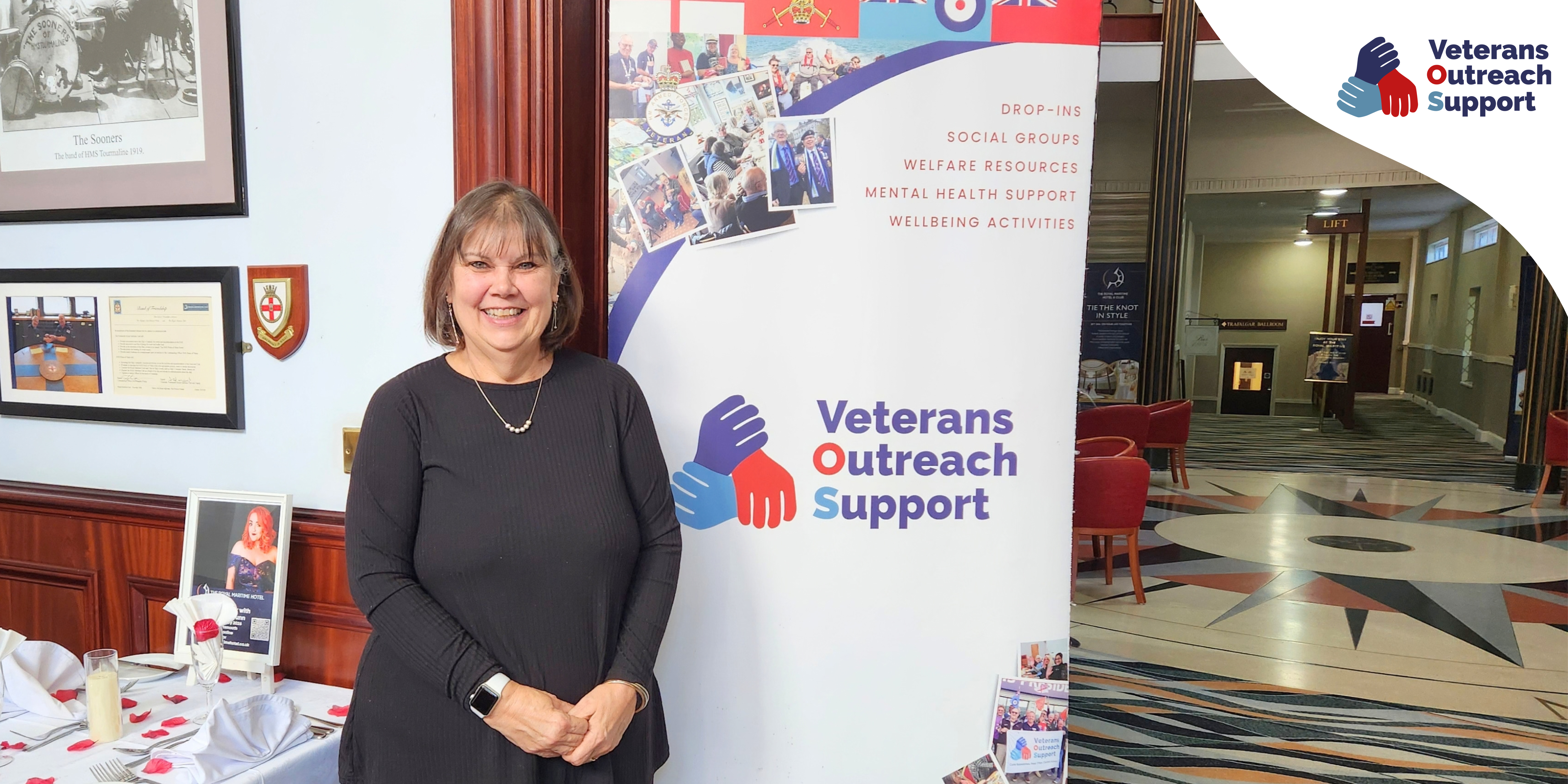
When Karen, retired Navy Nurse and Falklands Veteran, first approached Veterans Outreach Support (VOS) for help with her pension, she was looking for practical advice. What she found was much more: a supportive community, understanding and encouragement from the VOS team and fellow veterans.
In her own words, Karen shares her story.
“My name is Karen and in 1982 I was a Naval Nurse in the Queen Alexandra Royal Naval Nursing Service and served aboard the Hospital Ship Uganda during the Falklands Conflict. At the time, I was working nights at the Royal Naval Hospital Haslar.
When the conflict began, we all joked that you never volunteer for anything in the Navy – the Navy volunteers you. I thought being on nights might spare us, but one morning, after finishing a shift – I was told to go home and pack, and was on 48 hours’ standby for deployment to the Falklands.
I was 21 years old and truth be told, terrible at geography. When they said “Falklands” I thought it was somewhere near Scotland. I celebrated my 22nd birthday that July on the Falkland Islands – in the snow! We were away from April until August, returning to Southampton after the conflict ended.
My mother had completely forgotten I was even in the Navy until she heard the news. My brother was in the Submarine Branch but hadn’t completed his part three, so he didn’t go. I, on the other hand, was soon boarding a Hercules aircraft – my first flight ever. I’d never been on anything bigger than the Gosport Ferry and suddenly I was flying halfway around the world to live on a converted cruise liner for four months.
The Uganda had been an educational cruise ship for schoolchildren. When war broke out, the children were disembarked in Naples and flown home. The ship then sailed to Gibraltar, where it was transformed into a hospital ship in just 72 hours. A flight deck was added; wards were built and the ship’s purpose changed overnight. There’s still a plaque in Gibraltar commemorating that rapid transformation.
We didn’t know it at the time, but the ship contained asbestos. In 1982, there was no PPE, no health and safety briefings – just orders and action. We were told we were heading only as far as Ascension Island, but when HMS Sheffield was hit, everything changed. We refuelled at Ascension and were immediately redirected south.
On the way, we had stopped briefly at Freetown in Sierra Leone, because the ship’s Captain, had fallen seriously ill and had to be taken off to go to a hospital. We couldn’t go ashore, as the country’s president had just been assassinated – so we stayed only long enough to transfer the patient. Then we continued our journey to the South Atlantic.
First time I had set foot ashore on the Falklands on 13 July – my birthday – and that was also when the Uganda was converted from a Hospital Ship into a troop ship with her new original SS colours and not more Big Red Crosses. Under the Geneva Convention, hospital ships couldn’t carry arms, so once the fighting ended – we had to change status to bring troops home. We brought home the 7th Regiment Gurkhas and the 33rd Field Regiment Medics and even one injured Falkland Islander who needed care on the voyage back.
When we finally returned to Southampton in August, the docks were lined with people waving flags. It was emotional, surreal and overwhelming. I had joined the QARNNS 11th June 1979 and served until June 1988 – nine years in total. After the conflict, I returned to Haslar but couldn’t settle. I transferred to Plymouth by a swap draft with someone and worked at the Royal Naval Hospital Stonehouse for a year until my purse was stolen there, which forced another move. I went back to Royal Naval Hospital Haslar, then to HMS Sultan’s sick bay, and finally back to Haslar again before leaving the service.
I married in 1985 while stationed at HMS Sultan. My husband was also in the Navy, in the Submarine Branch, often away for six months at a time, when on the Diesel Subs but then four months on four months off when on nuclear subs after diesel submarines were decommissioned.
After leaving the Queen Alexandra Royal Naval Service, I worked as an agency nurse at Queen Alexandra’s, St Mary’s in Portsmouth and Royal Naval Hospital Haslar. We tried for children for four years, suffering two losses before our son was born in 1990 and our daughter in 1991. I gave up nursing for ten years to raise them – childcare was expensive and scarce then, especially for two children so young. When my husband left the Royal Navy in 1999 (after 24 and a half years) I saw a newspaper advert for a “Return to Nursing” course at St Mary’s Hospital in Portsmouth.
He encouraged me to go which I did. I didn’t need the course professionally, but I needed it for confidence. I returned to nursing in 2000 and continued for the next 22 years.
I completed my conversion from Enrolled Nurse to Staff Nurse whilst still at Royal Hospital Haslar with the NHS. There I got a position in the theatre complex as a Recovery Nurse – stayed there till the Royal Hospital Haslar closed in July 2009 and we all transferred to the Queen Alexandra Hospital in Portsmouth. Inspired by my daughter’s studies after proofreading her dissertation (when I was at QA), I completed my own nursing degree in 2018 and eventually became a Practice Educator (Sister post) – a position that made my mother proud.
Then came COVID-19. The hospital became a war zone again. Education roles were suspended and I was redeployed to recovery, working alongside ITU teams. The sight of ventilated patients, the sounds, the chaos – it all brought back memories of the Falklands: the burns, the drownings, the gunshot wounds. I suffered a breakdown and burnout.
When I contacted my GP surgery, the mental health nurse at my GP surgery turned out to be an ex-Navy man himself, which made it easier to talk to him. He understood where I was coming from straight away. He put me in touch with some support services and sent me a pack of information – links, contacts, and details of places that could help veterans. One of them was a centre on Gosport High Street that offered support specifically for veterans, though I believe it’s no longer there now.
He also pointed me in the direction of VOS. I also had support from Keith Malcolm, the veteran lead at QA Hospital, who had once been my mentor during one of my degree modules, so I already knew him well. He became my rock during that difficult time, calling me every Friday without fail to check how I was doing. His support meant the world to me. Knowing the right people to contact, Keith reached out to the VOS on my behalf and arranged for someone to get in touch. Not long after, I received a call from one of the VOS psychologists who would go on to help me take the next steps in my recovery.
He confirmed the diagnosis, explaining that I was suffering from PTSD linked to earlier experiences on the Uganda in the Falklands. He recommended psychotherapy, and I was soon referred for treatment with a therapist named Helen at VOS. This was completed over the phone due to the covid restrictions and I had 12-14 sessions. I later was seen by Op Courage after the initial therapy was not working and my friend said I need to go back for more help and was re-referred to VOS for additional therapy from Anthea who then suggested EMDR. The support I received was time limited and I was discharged with a message to call them if I needed further support.
People like Jim. Mark from VOS and Keith (QA), all ex-military became lifelines! I needed support getting my war pension sorted out and VOS helped me through this arduous process – it took a lot of work to get all the information together, which included preparation for a legal tribunal. Their longstanding support helped me endure this difficult journey. It was extremely difficult to prove. Veteran UK had calculated a pension amount which Jim, a VOS Welfare Officer, agreed did not reflect my service. As a serving nurse, little record was kept and often the nurses who served onboard the Uganda during the Falklands conflict were not recognised as war veterans.
“During the appeals process, I was forced to drag up all that stuff that I was trying to forget. But all the hard work and support from the team at VOS paid off – It was most important to be believed, and I was relieved when 2 appeals later, the tribunal finding, was in my favour. They were there for me all along this painful journey which was long, trying and their support led to a positive result and a sense of acceptance for me.”
Even now, hospitals and medical dramas trigger flashbacks. I can’t watch these programmes, and I haven’t been back to the Queen Alexandra or any big hospital with ITU facilities since leaving. I still get night terrors, though not as often.
But I’ve made peace with that. I’m 65 now, I often say, “and I could still be working if things were different. But I’ve accepted it. I gave everything I could – to my patients, to my service and to nursing. And I’m proud of that.”
I also knit/crochet scarves and blankets for Falklands veterans, this was started by a Falkland islander who wanted to say thank for the island’s liberation. This has enabled me to meet fellow Falkland’s veteran, and established some friendships”
What would you say to someone who finds themselves in need of mental health or support with things like pensions?
“I know that Veterans Outreach Support are always available to me if I need support or just to connect with someone, they know my story and they understand.”